≣ Sunrise From A City
 Golden Hour
 Abstract :
  There is something magical about the early morning in a busy city where even the city lights have ebbed to a mere inkling. The dark sky lay above me as an inky canopy of darkness freckled only by the fewest of stars, and I liked knowing that in a mere few hours it would be a bright blue winter’s day in the Middle East.
 In most parts of the world the Sun is consistent in its rhythms. Each day it goes up. And then it goes down. Sunrise, sunset. Now, I’ve written about sunsets at least two or three times before on this publication’s pages. But not, until this moment, about sunrises. And I’m pretty sure that, like me, scribes and photographers (and just about everybody else) over the years generally have spent a lot more time gazing at and thinking about our star’s settings rather than its risings. Probably has something to do, in many cases, with their not wanting to freeze at six or seven o’clock in the morning.


A sunrise trek through wild solitude in New York City.
It was super early, not yet four o'clock in the morning, when I set out on a Bronx-bound local train at the start of an urban hike that would take me through some of the wildest places in Manhattan.
This isn't how my hikes usually start. Usually I'm driving back roads searching for a hiking trail.
But on this day the subway dropped me at 125th street on the edge of Harlem. I climbed out of the station to a city still asleep, just one solitary guy setting up a fruit stand on the sidewalk.

After getting my bearings, I put on my headlamp and set off into the tangled wilds of Morningside Park. This isn't really wilderness, but in the early darkness it felt like it.
A few minutes walking brought me into winding trails where I was surrounded by birds flitting through the trees.

I hiked on and it was magical how remote the park could seem. The trail was so windy in places, the trees so thick, I had to use my phone to figure out where I was. I managed to get lost in a forest in the center of Manhattan.

I hiked on and in places I could see the stars merging with the lights of the skyline. I love New York City, the noise, the encounters with strangers and the hectic pace.
But I also have a hunger for solitude. On this walk, under a glowing moon, it felt like I had this beautiful place all to myself. One discovery — in Morningside Park and after crossing into Central Park — was the abundant water. There are lakes and ponds everywhere. Winding streams tumble down in little waterfalls.

My goal was to reach what may be the wildest corner of Central Park - 36 acres of hills and forest near the Upper West Side called the Ramble. These woodlands were planned and planted this way over a century ago, made to resemble the Catskills or the Adirondack Mountains.
I made it just in time to see the sun rise, scrambling up an outcrop of stone as the skyscrapers turned orange and rose and blue. Millions of people all around me, but here it was just birds and wind in the trees and the sun rising over the city.
The Norwegian Town Where the Sun Doesn’t Rise
I spent a year in Tromsø, Norway, where the “Polar Night” lasts all winter—and where rates of seasonal depression are remarkably low. Here’s what I learned about happiness and the wintertime blues.
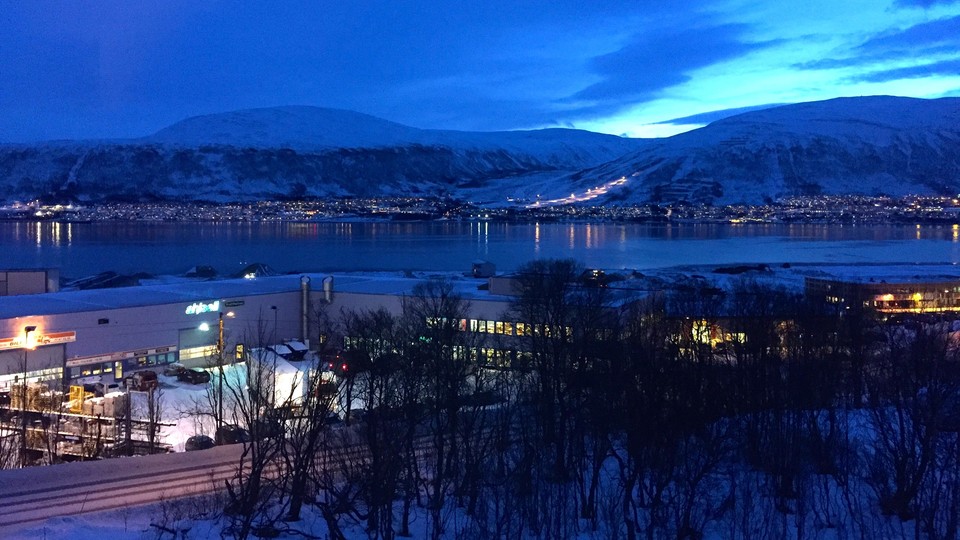
“I could never live there,” was the most common response I heard. “That winter would make me so depressed,” many added, or “I just get so tired when it’s dark out.”
But the Polar Night was what drew me to Tromsø in the first place.
Despite the city’s extreme darkness, past research has shown that residents of Tromsø have lower rates of wintertime depression than would be expected given the long winters and high latitude. In fact, the prevalence of self-reported depression during the winter in Tromsø, with its latitude of 69°N, is the same as that of Montgomery County, Maryland, at 41°N. While there is some debate among psychologists about the best way to identify and diagnose wintertime depression, one thing seems clear: Residents of northern Norway seem able to avoid much of the wintertime suffering experienced elsewhere—including, paradoxically, in warmer, brighter, more southern locations.
I first learned of Tromsø two years ago, as a recent college graduate looking for more research experience before applying to graduate school for social psychology. In search of an opportunity that would allow me to explore my interests in positive psychology and mental health—and satisfy my sense of adventure—I stumbled upon the work of Joar Vittersø, a psychologist at the University of Tromsø who studies happiness, personal growth, and quality of life.
After reaching out to him via email, I learned that the University of Tromsø is the northernmost university in the world. It seemed like the perfect place to test just how adventurous I really was, while also providing a unique population for a psychology research study: How do the residents of northern Norway protect themselves from wintertime woes? And could these strategies be identified and applied elsewhere, to the same beneficial effects?
Tromsø is a tiny island, roughly the same size as Manhattan, and is home to approximately 70,000 inhabitants, making it the second-most populated city north of the Arctic Circle. With everything a person could “need”—a mall, three main shopping streets, and a few movie theaters—but nothing extra, Tromsø felt more like a small suburb than a city. Surrounded by mountains and fjords on all sides, it also felt isolated and wild.
For all that, I soon found Tromsø likable. In a relatively small city, I was pleasantly surprised to find it home to an astounding number of festivals, cultural events, and city-wide celebrations. The main pedestrian street is thrumming every day of the week except Sunday, when most shops are closed, and is particularly lively on Saturdays and after 2 a.m. on weekends.
I settled into my student-housing apartment, with its amazing fjord views and three Norwegian roommates, and began building my Tromsø life. I took Norwegian lessons, which I used mostly to decipher food items in the grocery store, as almost everyone in Norway speaks English. I found a group of friends composed mostly of European international students, all of whom shared my desire to experience all that Tromsø had to offer (and to do it cheaply— Norway is prohibitively expensive). Instead of frequenting bars and restaurants as I had in the U.S., I enjoyed hikes, cabin trips, and yoga with my new friends. I joined several Norwegian meditation groups, which gave me friends outside the student community, and my Norwegian friends in these groups were kind enough to hold conversations in English for my benefit.

I soon found my routine: work on my research and graduate-school applications during the week, and enjoy the outdoors and potluck dinners on the weekends. Over several months, Vittersø and I laid the groundwork for our study, expanding upon the background research I had conducted before coming to Tromsø, deciding what questions we wanted to ask, recruiting participants, and testing the online platform we would use to distribute our survey. I became more comfortable spending time alone, and frequented Tromsø coffee shops where I would spend the day working or reading, nursing a $6 latte to the point of loitering.
As I became more at ease in my foreign surroundings, I discovered an additional benefit of my research topic: Almost everyone I spoke with—in casual conversations, at parties, over psychology-department lunches at the university—had a theory as to why their city flourished during the Polar Night. Some people swore by cod-liver oil, or told me they used lamps that simulated the sun by progressively brightening at a specific time each morning. Others attributed their winter well-being to community and social involvement, Tromsø’s wealth of cultural festivals, or daily commutes made by ski. Most residents, though, simply talked about the Polar Night as if it wasn’t a big deal. Many even expressed excitement about the upcoming season and the skiing opportunities it would bring.
Even so, it wasn’t until October, several months into my project, that I realized I might be asking the wrong kinds of questions. The crystallizing moment was a conversation with my friend Fern, an Australian transplant who had been in Tromsø for more than five years, about how long I was planning to stay. Although my grant technically ended in May, I explained that I hoped to stay through as much of the summer as possible. (Tromsø has only two seasons: a long winter, and a brief summer that arrives almost overnight sometime between late May and late June, at the start of the Midnight Sun period.) “It would be a shame to make it through the winter only to leave right before the best season,” I said.
Comments
Post a Comment